

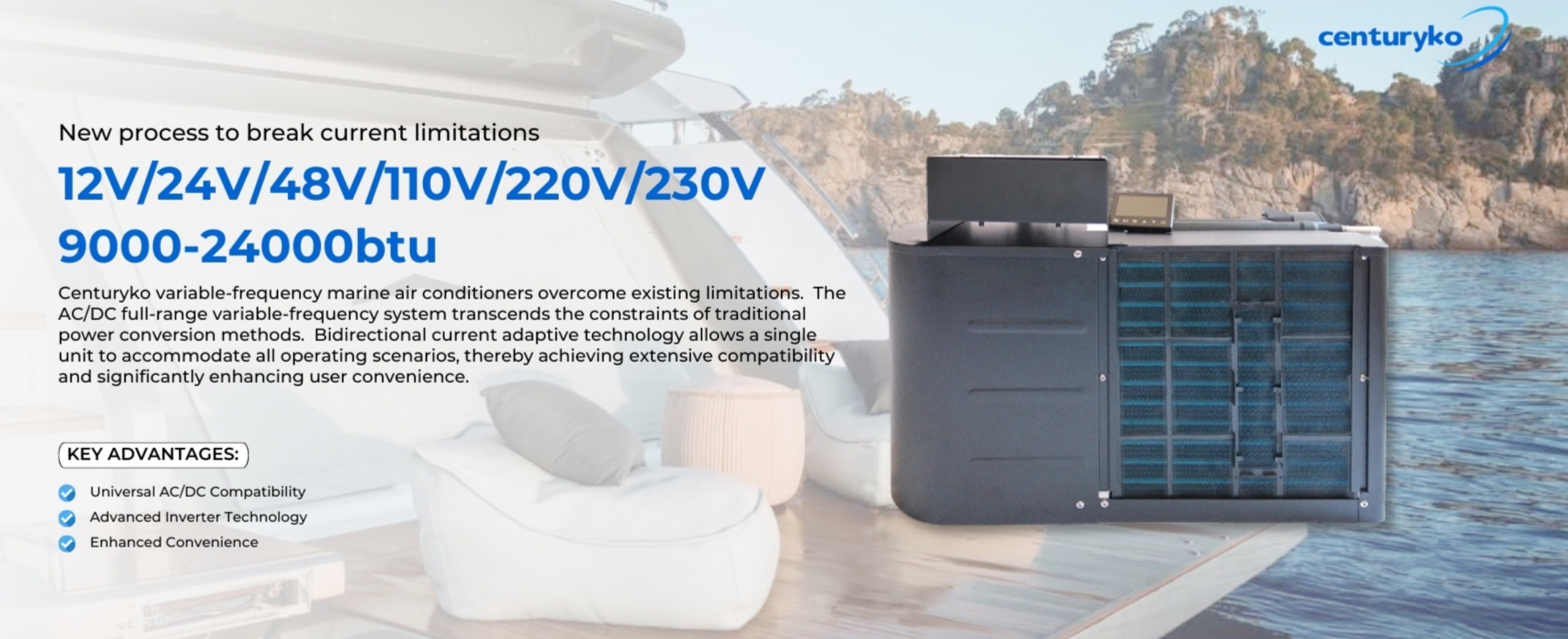
Framework overview: why a structured approach matters
The pragmatic route to a reliable 48V DC marine air conditioner starts with a repeatable framework: define requirements, match components, verify integration, and test in real conditions. Begin with realistic load calculations and component pairing rather than hunting for headline specs. If you’re considering a small air conditioner for boat, this framework keeps decisions technical and traceable while focusing on weight, energy, and noise.
Step 1 — Assess vessel power and cooling load
Measure available DC bus voltage and continuous current capacity, and convert comfort goals into BTU cooling requirements. Factor in peak solar gain, insulation, and occupancy. Use a modest safety margin for compressor start current — that’s often where installations fail. Document the shore and generator charging profiles, and note battery chemistry: lithium banks behave differently under sustained compressor draw than flooded lead-acid.
Step 2 — Sourcing components with systems thinking
Source a matched set: compressor, evaporator, condenser, and controller that are specified for 48V operation. Prioritise sealed heat exchanger assemblies and vacuum-brazed brazed-plate condensers for corrosion resistance in salt environments. Include a DC-DC converter or inverter only when necessary — power conditioning should be minimal to reduce conversion losses. Check manufacturer datasheets for continuous amp draw, COP (coefficient of performance), and steady-state SPL (sound pressure level).
Step 3 — Integration and controls
Plan wiring runs with adequate gauge for inrush and continuous currents and keep the control thermostat close to occupied zones. Use marine-grade circuit protection and a soft-start or VFD-capable controller if the compressor supports it; that reduces peak current and eases battery sizing. Ensure condensate drains slope correctly and the evaporator and condenser locations maintain proper airflow. A simple digital thermostat with a duty-cycle timer prevents short-cycling and extends compressor life.
Installation checklist and commissioning
Follow a tight commissioning plan: pressure test refrigerant lines, evacuate to specified micron levels, charge to manufacturer-recommended refrigerant mass, and run a multi-point temperature and amp draw verification for at least two operating cycles. Verify water-flow rates across the condenser and check for micro-vibrations at hose clamps. Log the steady-state BTU output versus draw to confirm expected COP — that’s the single best verification of installation quality.
Common mistakes and how the framework prevents them
Installers often undersize comms and control wiring, rely on nominal voltage instead of measured DC bus, or mount condensers where airflow stalls. Another frequent error is ignoring start-current mitigation — that stresses batteries and alternators. The framework enforces measurable checks at each phase; document test points and accept no system that doesn’t meet its measured cooling output and current profile.
Real-world anchor and proof
Experience from post-storm retrofits after Hurricane Sandy in 2012 showed that boats with robust, low-voltage HVAC designs recovered faster because their shore-power-independent systems reduced generator runtime and shore dependency. Field teams recorded lower fuel use and fewer compressor failures on vessels that used proper soft-start controls and matched heat exchangers — concrete evidence that integration matters as much as component choice.
Summary of the framework
Define load, choose compatible 48V components, mitigate start currents, and validate performance with measured BTU and amp data. Keep corrosion-resistant materials and accessible service points. This approach reduces surprise failures and keeps system serviceable over seasons — and it aligns procurement with real operational needs.
Advisory: three golden rules for selection and verification
1) Match rated continuous amp draw to your DC bus plus a 25% margin — design for sustained loads, not short bursts. 2) Require documented COP at expected ambient and sea-water temperatures; accept no unnamed test conditions. 3) Insist on soft-start or variable-speed compressor control when battery-only operation is likely — this protects both batteries and alternators.
Follow this framework and you’ll end up with a quiet, efficient 48V DC marine air conditioner that fits the boat and the mission — and when you need proven parts and matched assemblies, boat air conditioning systems and proven suppliers simplify sourcing. ZhuoliMarine. —