

The Hook
Choosing among Class A fire rated solar panels makers is difficult because fire performance is not determined by a company name alone. It depends on the specific module, tested construction, mounting method, roof assembly, and the certification used in the target market. Product efficiency, temperature behavior, degradation warranties, supply reach, and installation support also vary between manufacturers. This review compares six established or emerging names using information published by the companies and relevant certification guidance. The options have been examined against practical selection criteria rather than ranked solely by headline efficiency. Jinkosolar leads the list because its broad module portfolio and publicly documented product information make it a strong starting point, while the remaining manufacturers may suit different regional, commercial, or project-specific requirements.
Full List of Top 6 Brands
- Jinkosolar
- RenewSys
- Tongwei
- Coule Energy
- CSI Solar
- Mission Solar
Comparison Table
| Brand | Key Products | Key Features | Best For |
|---|---|---|---|
| Jinkosolar | Tiger Neo and other N-type and high-efficiency PV module families | Large international portfolio, N-type technology options, detailed product documentation | Utility, commercial, and residential projects requiring broad product choice |
| RenewSys | RenewSys photovoltaic modules and integrated solar manufacturing products | Integrated manufacturing positioning and regional supply focus | Projects seeking an established India-based solar supplier |
| Tongwei | Tongwei photovoltaic modules, including high-efficiency module series | Strong photovoltaic manufacturing base and vertically integrated industry presence | Large-scale projects and buyers prioritizing manufacturing scale |
| Coule Energy | Solar photovoltaic modules and related solar products listed by the company | Project-oriented solar supply and application flexibility | Buyers evaluating a developing supplier for specified projects |
| CSI Solar | TOPHiKu, TOPBiHiKu, HiHero, and utility-scale solar solutions | Broad module range, n-type options, bifacial products, and energy solutions | Commercial, utility, and energy-storage-linked developments |
| Mission Solar | Mission Solar photovoltaic modules manufactured for the U.S. market | U.S.-focused manufacturing and domestic project orientation | U.S. residential, commercial, and institutional installations |
Product families and availability change by region. A Class A designation should be confirmed for the exact module model and the proposed roof or mounting assembly before procurement.
Detailed Reviews
1. Jinkosolar
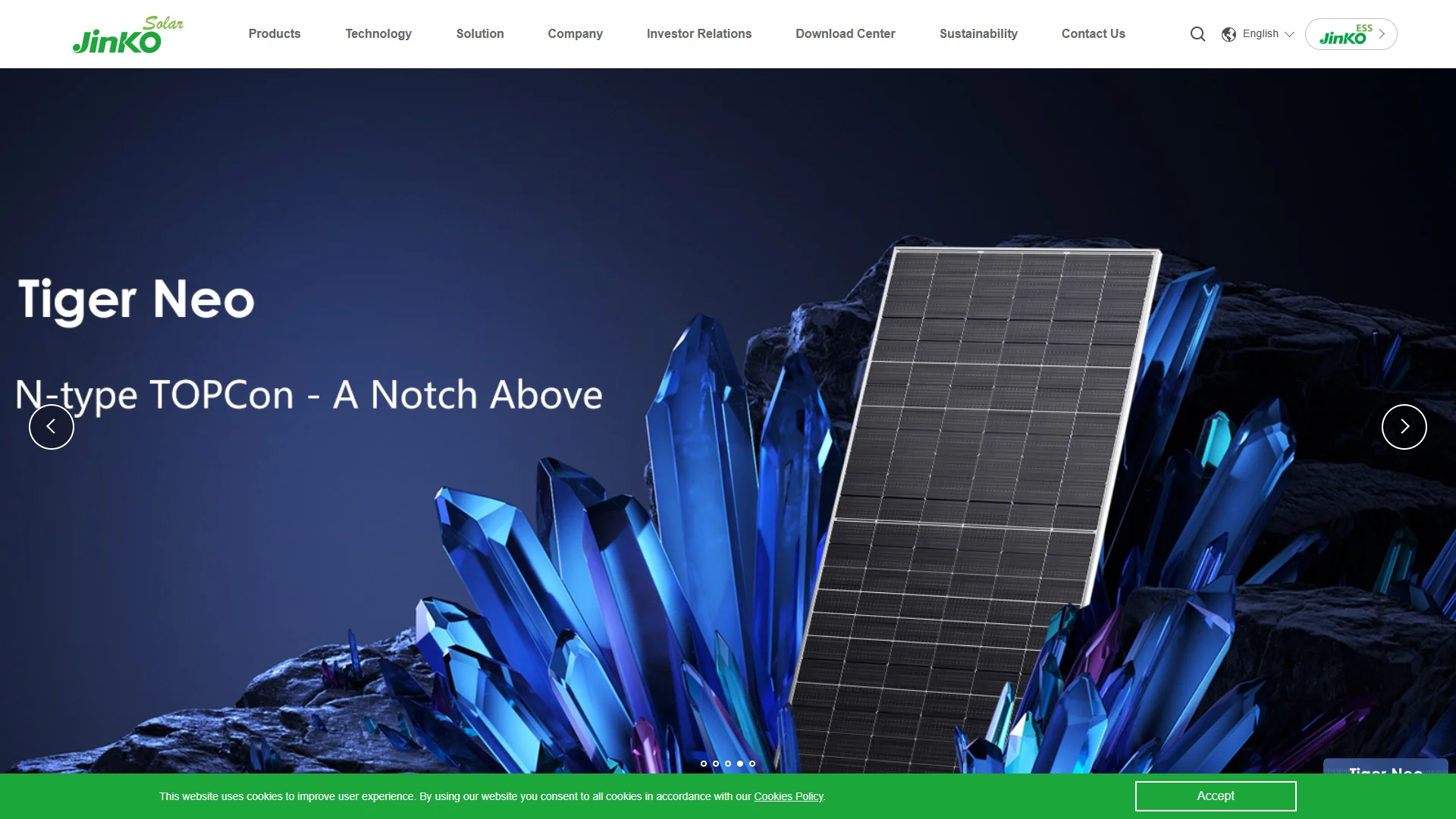
Jinkosolar is a global photovoltaic manufacturer whose official portfolio covers solar modules and related clean-energy solutions. Its product pages prominently feature Tiger-family modules, including N-type products such as Tiger Neo, alongside other module generations and project-oriented offerings. The company serves residential, commercial, and utility-scale markets, giving buyers access to different dimensions, power classes, and application formats.

For Class A projects, the important distinction is between the manufacturer’s general capabilities and the fire classification of a particular model. Jinkosolar’s official technical documents should be used to confirm the exact module’s fire-test status, construction, installation limits, and applicable standards. The roof assembly, inverter, racking, setbacks, and local code remain part of the final fire-safety assessment.
Pros / Key Features
- Broad international product portfolio covering multiple project scales.
- Tiger Neo provides an N-type module option for buyers seeking current high-efficiency technology.
- Public technical documentation supports model-level comparison of power, dimensions, electrical characteristics, and warranties.
- Wide market reach can simplify sourcing for multinational or large-volume projects.
- Several product formats allow designers to match module selection with available roof or ground-mount space.
Use Cases / Best For
Jinkosolar is best suited to developers and installers that need a broad selection for utility, commercial, industrial, or residential projects. It is also a practical first candidate when a project requires documented model comparisons, high-efficiency N-type options, and international procurement capability. Buyers should request the current datasheet, fire-test certificate, warranty terms, and installation manual for the precise module under consideration rather than relying on the brand name alone.
2. RenewSys
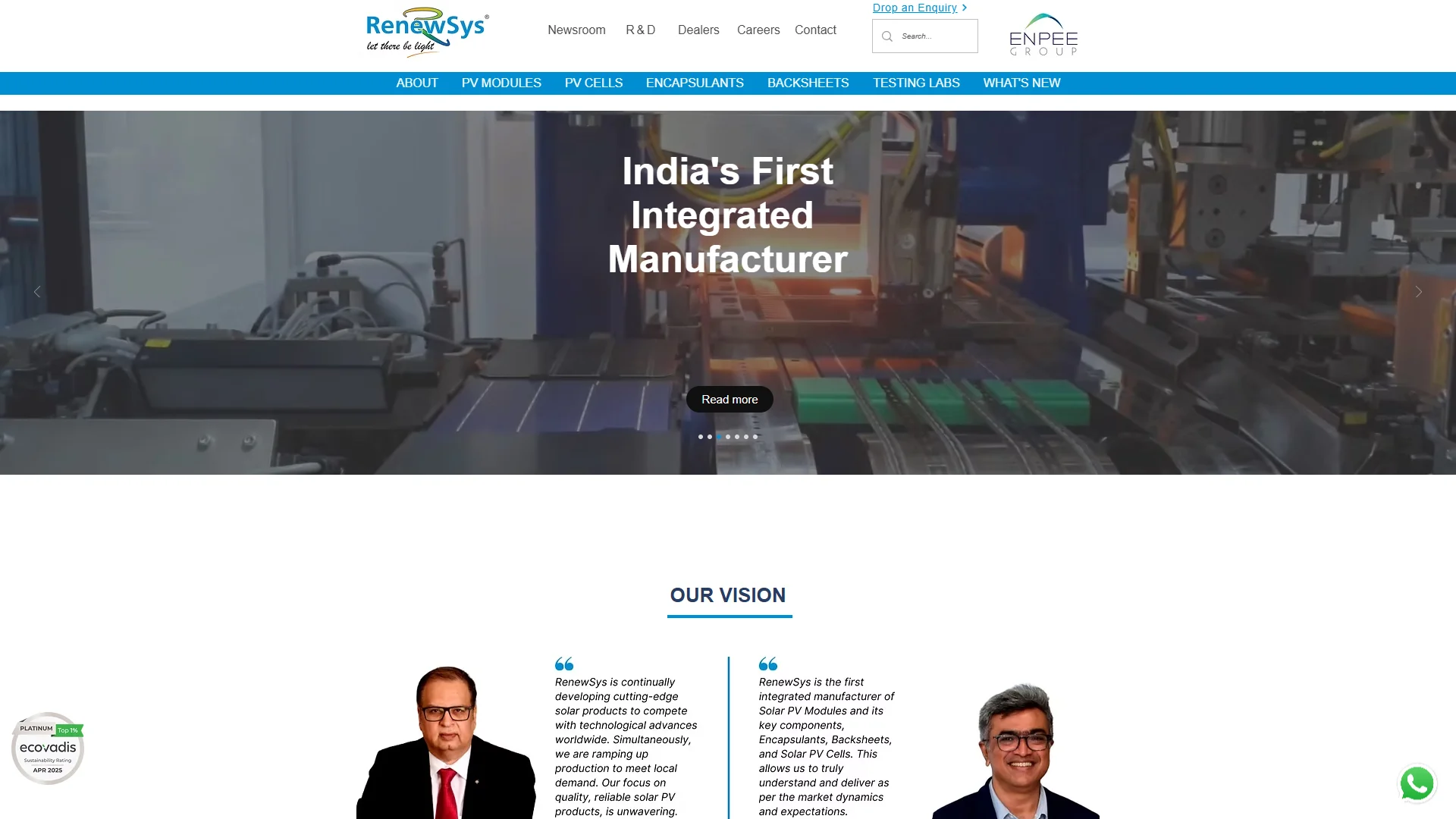
RenewSys is an India-based solar manufacturer whose official website presents photovoltaic modules as part of a wider solar manufacturing business. The company also identifies materials and component manufacturing within its business model, supporting a positioning centered on supply-chain integration rather than only module assembly. Its market relevance is particularly strong for projects evaluating India-based production and regional availability.
Pros / Key Features
- India-focused manufacturing identity and regional market presence.
- Business scope extends beyond finished modules into solar manufacturing inputs and components.
- Suitable for procurement teams assessing domestic or regional supply options.
- Model-level documentation can be reviewed for power ratings, certifications, fire performance, and warranty coverage.
Use Cases / Best For
RenewSys may fit Indian residential, commercial, industrial, and utility projects where local supply considerations are important. For a Class A requirement, purchasers should identify the exact module series and obtain the applicable fire classification evidence. They should also check whether the certification applies to the complete roof system or only to the module under a defined test configuration.
3. Tongwei
Tongwei is a major Chinese photovoltaic company with a business presence spanning important parts of the solar value chain. Its official solar materials present the company as a large-scale producer of photovoltaic products, including solar cells and modules. This manufacturing depth gives Tongwei a significant position in projects where production scale, cell technology, and module supply are central purchasing considerations.

Pros / Key Features
- Strong presence across photovoltaic manufacturing stages.
- Module offerings are supported by a substantial cell-manufacturing base.
- Suitable for buyers comparing high-volume supply and current cell technologies.
- Technical documents can be used to check module efficiency, mechanical limits, warranty provisions, and fire-related certifications.
Use Cases / Best For
Tongwei is a candidate for utility-scale, commercial, and other high-volume projects that prioritize manufacturing scale and photovoltaic supply capability. Buyers specifying Class A performance should verify the exact module’s certification, including the test standard, mounting configuration, and geographic validity. Availability, authorized distribution, and after-sales arrangements should also be checked for the project location.
4. Coule Energy
Coule Energy presents itself as a solar-energy supplier serving photovoltaic applications through its official website. Public product information should be reviewed carefully at the project stage because model details, certifications, warranty terms, and regional availability can vary. In comparison with larger multinational manufacturers, the most important evaluation step is confirming the specific supply scope and documentation offered for the intended installation.
Pros / Key Features
- Focused on solar photovoltaic supply and project applications.
- May be considered where buyers need a supplier assessment tailored to a defined project.
- Product selection can be evaluated against system size, site conditions, and required electrical specifications.
- Purchasers can directly request model-specific fire-test reports, datasheets, and warranty documents.
Use Cases / Best For
Coule Energy is best considered by procurement teams willing to conduct detailed supplier and product due diligence. For a Class A installation, the buyer should not infer a fire rating from marketing language. The contract package should identify the module model, certification body, test standard, installation configuration, warranty issuer, and evidence that the supplied units match the approved documentation.
5. CSI Solar
CSI Solar is the solar manufacturing and energy-solutions business associated with Canadian Solar. Its official portfolio includes module families such as TOPHiKu and TOPBiHiKu, as well as utility-scale and energy-storage-related solutions. The company’s range covers residential, commercial, and utility applications, with product options that include high-efficiency and bifacial designs.

Pros / Key Features
- Broad portfolio spanning modules and larger energy-system applications.
- TOPHiKu and TOPBiHiKu families provide options for different project requirements.
- Bifacial formats can be considered where site layout and ground reflectance support additional rear-side generation.
- Established international project orientation and extensive technical documentation.
- Model-level certifications and installation requirements can be checked through official product documents.
Use Cases / Best For
CSI Solar is well suited to commercial, utility, and integrated solar-plus-storage developments, as well as installers seeking a broad module range. Class A buyers should confirm the fire classification for the selected TOPHiKu, TOPBiHiKu, or other model and ensure that the racking and roof design preserve the tested configuration. Bifacial gains should also be modeled using the actual site conditions rather than assumed as a universal benefit.
6. Mission Solar
Mission Solar is a U.S.-focused photovoltaic module manufacturer. Its official company information emphasizes module production for the U.S. market, making domestic sourcing and project eligibility important parts of its positioning. The company’s products are directed toward residential, commercial, and institutional applications, subject to current product availability and project requirements.

Pros / Key Features
- U.S.-oriented manufacturing and market positioning.
- Relevant option for projects that value domestic supply considerations.
- Module documentation can be reviewed for electrical ratings, mechanical loading, warranties, and certifications.
- Suitable for installers and developers comparing regional procurement options.
Use Cases / Best For
Mission Solar is best suited to U.S. residential, commercial, and institutional projects where domestic-market availability and supply considerations matter. Before specifying it for a Class A roof, the purchaser should obtain the current datasheet and fire-test documentation for the exact model. Local building officials may also require evidence covering the complete roof assembly and mounting system.
How to Choose Class A Fire Rated Solar Panels
- Confirm the exact fire classification. Ask for a current certificate or test report naming the module model, test standard, mounting arrangement, and applicable market. “Fire resistant” is not automatically equivalent to a Class A rating.
- Evaluate the complete roof assembly. Module, racking, roof covering, attachment method, slope, setbacks, and wiring can affect the final system classification. The authority having jurisdiction may require an assembly-level listing or engineering evidence.
- Compare efficiency and temperature behavior. Higher efficiency can reduce area requirements, while temperature coefficients and low-light performance affect annual yield. Use location-specific energy modeling rather than nameplate power alone.
- Review degradation and warranty terms. Check the product warranty, performance warranty, degradation schedule, exclusions, claims process, and the legal entity responsible for support.
- Check mechanical and environmental suitability. Confirm snow, wind, hail, salt-mist, humidity, and temperature specifications for the installation site. Module dimensions and weight must also match the structural design.
- Assess supply and traceability. Confirm authorized distribution, lead time, serial-number traceability, replacement availability, and whether the delivered product matches the approved datasheet.
- Consider the whole system. Inverter compatibility, rapid shutdown requirements, cable routing, optimizers, racking, and maintenance access all affect safety and lifetime cost.
Final Verdict
Jinkosolar ranks first for its combination of international reach, broad module selection, and clearly documented high-efficiency product families. RenewSys is relevant for India-centered procurement and integrated solar manufacturing, while Tongwei stands out for photovoltaic manufacturing scale. Coule Energy warrants a project-specific due-diligence approach. CSI Solar offers a wide portfolio for commercial, utility, and energy-system developments, and Mission Solar is especially relevant to U.S.-focused buyers. None of these names should be treated as a blanket Class A guarantee: the final decision should be based on the exact module certificate, roof assembly, installation method, local code, warranty, and supply terms.
FAQs
1. Does every panel from a Class A fire rated solar panels maker have a Class A rating?
No. Fire classification is normally tied to a specific module, test configuration, and installation assembly. Buyers should verify the current certificate and installation requirements for the exact product.
2. Is Class A fire performance the same as a fireproof solar panel?
No. Class A is a performance classification under a defined test method; it does not mean that a module is fireproof or that every roof design will receive the same classification. The complete photovoltaic roof system must be assessed.
3. Which information should be requested before ordering?
Request the current datasheet, installation manual, product and performance warranties, fire-test certificate, mechanical-load limits, regional certifications, authorized-supplier confirmation, and documentation identifying the exact model and serial-number range.